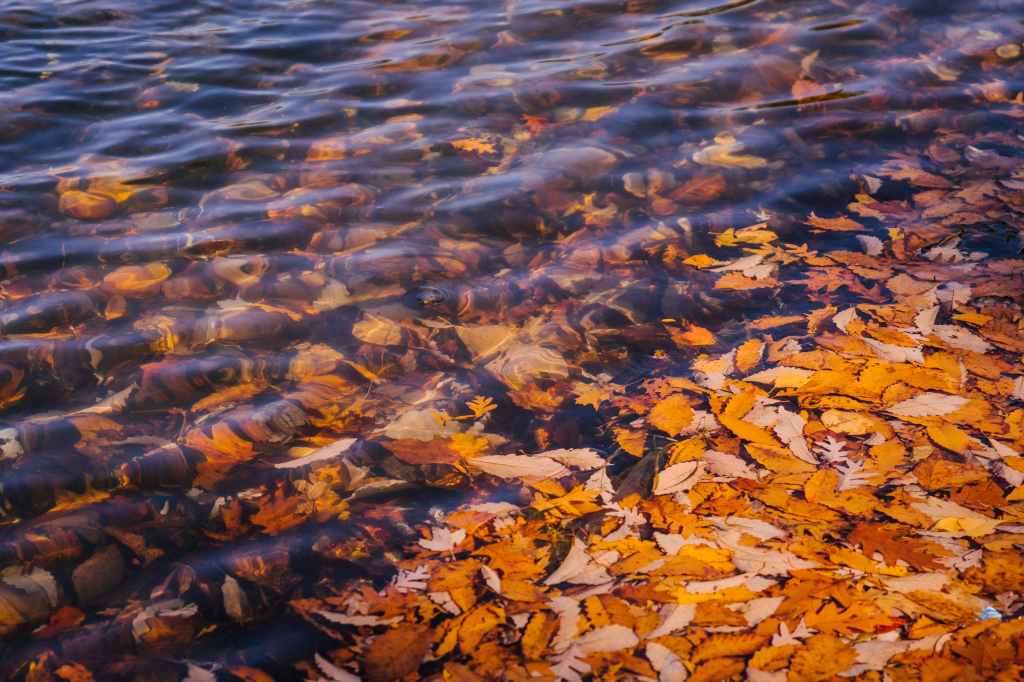
New pond syndrome vs old pond syndrome. The nitrogen cycle vs the organic carbon cycle. Most pond owners are familiar with the importance of the nitrogen cycle in establishing a new pond with an appropriately sized biofilter to detoxify ammonia and nitrites. Far fewer fully understand the organic carbon cycle and how, if not properly designed and maintained, a pond can slowly transform into an unhealthy, foul-smelling swamp over time. First let’s define organic carbon, which for our purposes includes mostly complex carbon-based molecules that were produced biologically. Proteins, carbohydrates, and lipids either fully intact or in the process of decomposing are the primary kinds of organic carbon that we as pond keepers should care about. Organic carbon enters our ponds as fish food, falling plant debris, dust, even bird poop (thanks again herons). Organic material is fairly water soluble, and can exist within our ponds in both the dissolved (DOM) and particulate (POM) forms. In healthy natural aquatic systems, most organic carbon exists in a dissolved state, while in our typically far dirtier ponds you will often find high accumulations of particulates (think pond sludge). Over time, aquatic organic carbon is SLOWLY broken down biologically into inorganic carbon compounds, primarily carbon dioxide (CO2) and methane (CH4), which are gases that bubble off and leave our systems, but this is a gradual process that typically occurs at a far slower rate than ongoing organic carbon additions to the systems. In other words, in the typical ornamental pond environment, organic carbon steadily builds up over time unless it is removed mechanically, which we will return to later.
Organic molecules are typically large, complex, and difficult to break down, which is why the process is slow and requires an army of bacteria, fungi, zooplankton, worms, snails, crustaceans, insect larvae, tadpoles, and even filter feeders like clams, mussels, and sponges. Most of these animals require oxygen, and the more organic material exists in your pond the greater your system’s biological oxygen demand will be. As we know, dissolved oxygen is a critical water quality parameter, and increasing organic carbon loads make it harder to maintain optimal oxygen levels throughout the pond. If these levels are not maintained (but to some extent even if they are), anaerobic organisms will start to dominate the organic carbon breakdown cycle, and unfortunately many of these are highly pathogenic and commonly infect and kill ornamental fish like koi and goldfish (and can even make you sick). The primary culprit and number one koi killer is the dreaded aeromona, causing ulcers and internal infections, but we also have to consider pseudomonas and the many ciliated fish parasites that thrive in organic rich environments but are rarely seen in clean ponds. Further, the biological breakdown of organic carbon releases tied-up nutrients from within the organic carbon molecules themselves like nitrates and phosphates which can promote excessive levels of nuisance algae growth and acidify your pond over time.
As you can see, organic material in your water is generally harmless in and of itself, but as it builds up in your pond over time the increased biological activity that it engenders can degrade water quality and promote excessive populations of pathogens (both fish and human) and nuisance algae. In nature, this is the primary process by which small, enclosed bodies of water slowly fill in over time to become bogs/swamps, which as we know are NOT productive systems conducive to large healthy happy fish.
So now that we understand the organic carbon cycle, how do we manage it in our ponds? The key is to prevent organic carbon from building up in our systems, which is primarily done with mechanical filtration. To be clear, mechanical filtration is completely separate and distinct from biological filtration, which deals specifically with the nitrogen cycle. Mechanical filters include skimmers to catch falling plant debris on the pond’s surface, but more importantly pressure filters, settlement tanks, RDF filters, and other dedicated components that trap organic material picked up from the bottom of the pond so that it can be efficiently purged, often with the flip of a valve. In less efficient systems without strong mechanical filtration routine manual cleanouts become necessary, but this is a dirty, difficult, expensive, and potentially health-endangering process that is usually unnecessary if a fish pond is designed and built correctly. To remove dissolved organic carbon, rather than just the visible particulates, regular partial water changes are often the easiest method. Most high-end koi ponds run with 10%+ weekly water changes, while lightly stocked systems and plant dominated water gardens need considerably less (unlike fish, many popular pond plants actually benefit from the pond to swamp transition).
Overall, how we manage the organic carbon cycle in our ponds over time is probably the number one determinant of long-term success or failure. It matters most for koi ponds and heavily stocked water gardens, but even in lightly stocked or plant-only systems, maintaining healthy levels of organic carbon is necessary to maintain adequate water quality, and too often is overlooked.
 Delaware Custom Ponds LLC
Leave a comment