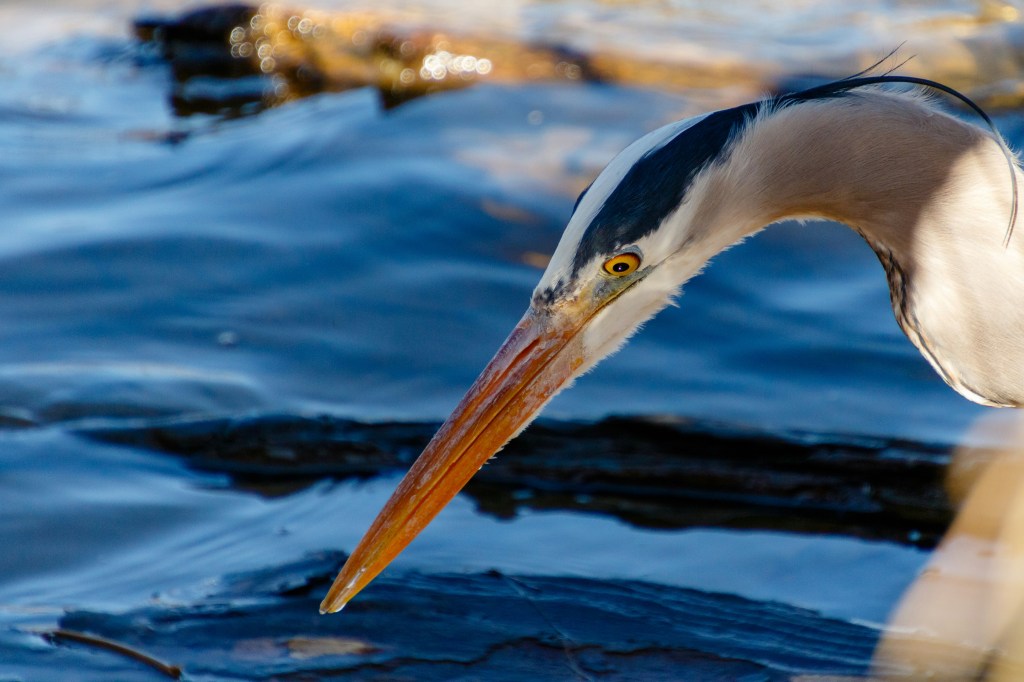
Here in the Mid Atlantic region, we are blessed with an abundance of big beautiful rivers, lakes, and other freshwater systems and over the last 50+years we’ve done an excellent job of cleaning them up. Fish populations have recovered and sometimes even exceeded historical levels, and with them our large native water birds including bald eagles, ospreys, and herons have made dramatic comebacks from what were dangerously threatened levels. While we can all agree that these iconic birds are beautiful to witness in nature, they are perhaps somewhat less than welcome at our ornamental ponds when they snack on our koi and goldfish with impunity, giving the expression “like shooting fish in a barrel” new meaning. Let’s go through each of the big 3 common fishing birds, their hunting habits, and how they can be deterred from successfully hunting our ornamental ponds.
Herons, specifically the great blue heron, are the number one predator at koi ponds and water gardens due to their size (4 feet tall and 6.5 feet wingspan), appetite (can eat more than a pound of fish per day), and versatile hunting skills. They are excellent spearfishers, using their 6+ inch beaks and elongated necks to stab at fish near the surface of the water. With their long legs, they are comfortable hunting both at the water’s edge and also standing in water up to 2 feet deep. Unlike ospreys and eagles, herons also have excellent low light vision and can hunt effective at dawn, dusk, and even at night. So how can we hope to deter herons at our ponds? The key here is area denial. Herons rely on accurate beak strikes from stationary standing positions to be successful, so denying them comfortable perches at the pond area is key. Successful heron management starts at the pond design stage. Building deeper ponds (greater than 2 feet) without shallow plant shelfs/ledges prevents herons from hunting inside the pond where they can do the most damage, and also building up some of the rear and side pond edges above the water level by 1 foot or more using landscaping plants, stones, or other materials can deny heron access to those areas. Beyond pond design considerations, stringing up clear fishing line can block off higher risk approaches, and pond netting can be used over the pond as a last resort, but hopefully it doesn’t have to come to that. Some people have also claimed success with motion activated sprinklers or various heron/predator decoys, but I wouldn’t rely too much on those as long term solutions given the well documented intelligence and persistence of these beautiful birds.
Let’s move on to ospreys, the second most common large avian pond predator. Ospreys are slightly smaller than herons (2 feet long and up to 6 feet wingspan) but they compensate with their oversized claws and more conventionally shaped beaks that allow them to successfully hunt and consume much larger fish than the great blue herons can handle. Note that because of shape of their spear-like beaks, great blue herons cannot shred their prey and must swallow it whole, which typically limits them to pond fish less than 1 foot long, whereas ospreys (and eagles) have beaks that are perfectly suited to shredding and are only limited in terms of their ability to grab their prey and carry it off. Ospreys can consume fish up to 4 pounds in weight (~18 inch koi) while bald eagles can take fish even heavier (10 pounds plus). Also, unlike herons, ospreys hunt from the air by dive-bombing their prey from above, typically starting their dives from 30-50 feet above the water or even higher. They dive fast (up to 50 mph), can come in at fairly extreme angles (45 degrees or steeper), grasp onto fish in water up to 3 feet deep with their claws, and unlike bald eagles can completely submerge themselves in water without any risk of drowning. Fortunately, ospreys are typically less common around ornamental ponds than herons, but if you happen to be in an area where they live you may need to create obstacles to disrupt their flight paths. Siting your pond under the cover of trees, under a pergola, or stringing up a shade sail or fishing line can create the necessary obstructions to deter ospreys. Some people also claim that predator decoys like fake alligator heads can also work, but as with herons I’d caution against insulting the intelligence of these majestic birds.
Last but not least, let’s discuss bald eagles. Bald eagles are much bigger and stronger than herons and ospreys (3.5 feet long, 8 feet wingspan, up to 12 lbs), but they are also somewhat less common at our ornamental ponds and much prefer to hunt large, wide open bodies of water. Their greater size and weight is at least partially responsible for this, as bald eagles are not quite as maneuverable across shorter distances as ospreys are, and they also cannot dive bomb at extreme angles and submerge themselves in the water like ospreys. As such, bald eagles often hunt fish by building up speed flying low and horizontally over the water’s surface (but they can also dive downwards up to 100 mph), lowering their claws into the water when they can spot a fish near the surface and then catching and flying off with it without stopping. Most ornamental ponds are far too small with too many adjacent landscaping obstacles for a bald eagle to even consider hunting, given their need for a wide open flight path. However, bald eagles are also smart and opportunistic scavengers, and they can take fish by “walking into” extremely small shallow ponds, or pick up sick fish along the sides. But in most cases bald eagles are not much of a problem in conventionally sized garden ponds. Farm ponds however can be a very different story.
Taking a step back, experiencing herons, ospreys, and eagles around us is actually a great privilege, and with a bit of understanding and forethought, we can still enjoy our koi ponds and water gardens while living alongside them.
 Delaware Custom Ponds LLC
Leave a comment